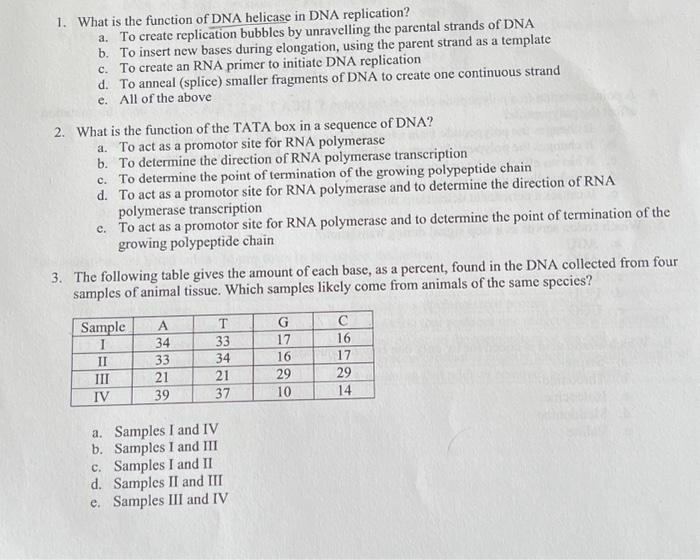
Solved 1 What is the function of DNA helicase in DNA Biology Diagrams Unwinding polarity of replicative helicases. (A) Gram-negative bacteria E. coli and Helicobacter pylori helicase hexamer unwind double-stranded DNA in the direction of 5′ to 3′. Similarly, Gram-positive bacteria Bacillus anthracis and Bacillus stearothermophilus also showed a 5′ to 3′ unwinding activity. The DnaC helicase of Bacillus subtilis with 45% and 82% identical amino acid
Helicases initiate the replication fork, where the DNA double helix is separated into two single strands. This separation allows DNA polymerases to synthesize new complementary strands. Helicases work with other proteins, such as single-strand binding proteins, which stabilize the unwound strands and prevent re-annealing or secondary structures. What is Helicase? Helicases are a class of enzymes that play a fundamental role in unwinding nucleic acids, either DNA or RNA, depending on the type of helicase involved.These enzymes are essential for various cellular processes, including replication, repair, transcription, and translation.Helicases were first identified in E. coli in 1976, and later, eukaryotic DNA helicases were discovered

DNA Helicase and Its Role in Replication, Repair, and Disease Biology Diagrams
DNA helicases are ubiquitous enzymes found in all domains of life and associated with nucleic acid metabolisms such as DNA replication, transcription, translation, DNA repair, recombination, ribosome biogenesis, and decay.. DNA helicase was discovered first in E. coli in 1976.. They are ATP (adenosine triphosphate) dependent separating enzymes that promote separation of the two parental

DNA helicase is a crucial enzyme in molecular biology, playing an essential role in DNA replication, repair, and transcription. As a motor protein, it unwinds the double-stranded DNA (dsDNA) into single strands, enabling cellular processes that require access to the genetic code. Superfamily 1 (SF1) helicases function as monomers or dimers, often involved in DNA replication and repair. UvrD helicase, for example, plays a role in nucleotide excision repair. SF1 helicases possess two RecA-like domains that facilitate ATP binding and hydrolysis, driving translocation along single-stranded DNA.

Biology Simple Biology Diagrams
Role in DNA Repair. Helicases play a significant role in DNA repair, ensuring the maintenance of genomic stability by addressing damage and errors that can arise from various sources, including environmental factors and replication stress. Their involvement in repair mechanisms highlights their adaptability and precision in responding to DNA
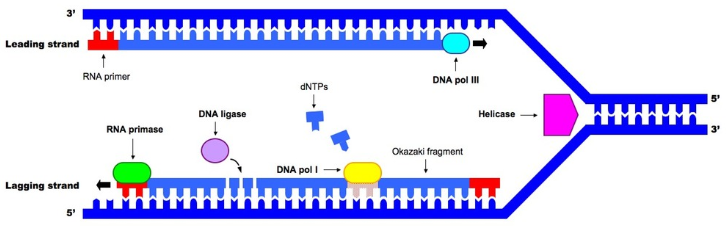
Helicase plays a crucial role in the DNA replication process. It is also known as Dna B protein. It is a ring-shaped hexamer containing six identical subunits. During the replication process, each of the single-stranded DNA helicases is loaded. Then the DNA replication occurs in the bi-direction, unwinding the strand and creating the V-shaped
